
Effects (experimental)
An effect is a named, parameterized shader that enhances an ordinary layer. The document names it; page JavaScript registers it; documents never carry GLSL. The layer the effect sits on stays a complete static layer, and that layer is the effect’s fallback:
- without the effects package, the layer renders as authored;
- where an effect cannot run (globe projection, 3D terrain, no WebGL2, maplibre-gl 4), it declares absence — one console warning — and the layer renders as authored;
- on
mlym emit, the layer ships as authored, with onelossywarning per effect (export classes).
0.7 ships one backend — extrusions, shader effects on fill-extrusion
layers — and two built-in effects written against the same public API as
any third-party one:
| Effect | What it draws |
|---|---|
tonal-hatch | The Mapzen/Tangram crosshatch: pen-stroke density follows light per face — lit faces go to paper, shaded faces to dense ink — with a noisy paper margin and inked wall outlines. |
blueprint | A drafting grid whose lines sit a fixed number of metres apart on every face (they never stretch), faint shading, glowing edges. |

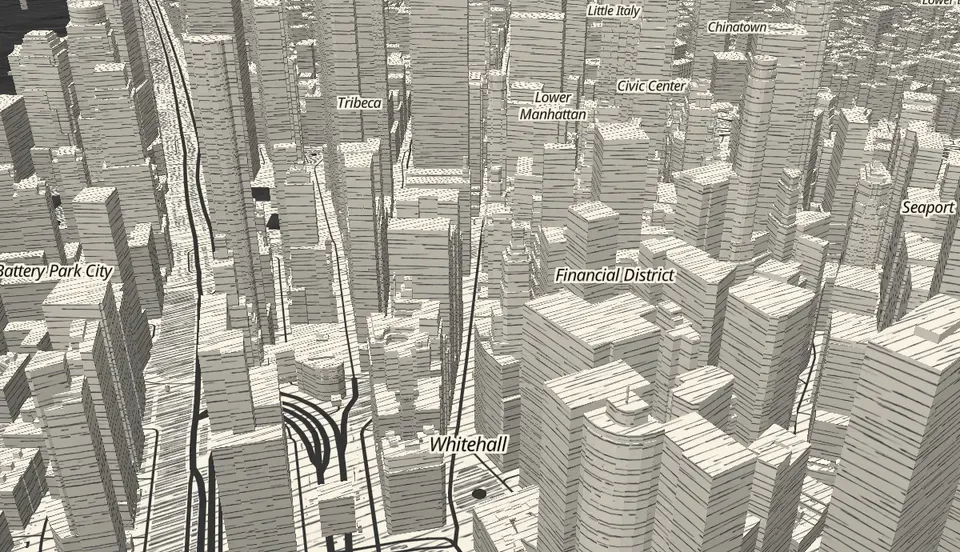

Authoring effect: in YAML
Section titled “Authoring effect: in YAML”Put effect: on a fill-extrusion layer: type names the effect, every
other key is a param.
type: mapid: crosshatchconfig: center: [-74.0118, 40.7075] zoom: 15.9 pitch: 60 bearing: 29 mapStyle: "https://demotiles.maplibre.org/style.json"images: building-hatch: { url: "https://example.com/hatch/building.png", pixelRatio: 4 } # the 3x3 tonal atlas tonal-hatch samples (Tangram's hatch.png) hatch-atlas: { url: "https://example.com/hatch/hatch-atlas.png" }sources: omt: type: vector url: "https://tiles.openfreemap.org/planet"layers: - id: buildings type: fill-extrusion source: omt source-layer: building minzoom: 13 paint: # the static fallback: one pen hatch on every face fill-extrusion-pattern: building-hatch fill-extrusion-height: ["coalesce", ["get", "render_height"], 10] fill-extrusion-base: ["coalesce", ["get", "render_min_height"], 0] effect: type: tonal-hatch gain: 0.72In format v2 the block lives in the layer’s
runtime: — an effect never compiles to style.json:
layers: - id: buildings type: fill-extrusion # ... runtime: effect: { type: tonal-hatch, gain: 0.72 }Heights come from the layer, not from the effect. The backend evaluates
the static layer’s own filter, fill-extrusion-height and
fill-extrusion-base with MapLibre’s expression evaluator — any source
schema works, zoom ramps included (evaluated exactly as MapLibre does, at
the tile’s zoom and the next, blended per frame). Effect and fallback always
stand at the same height.
Loading the package
Section titled “Loading the package”import "@maplibre-yaml/core/register";import "@maplibre-yaml/effects/register"; // built-ins + the <ml-map> hookThat is all: every <ml-map> whose document has effect: layers
validates their params (bad params are positioned parse errors, like the
rest of the format) and attaches the effects once the map loads, detaching
them on reload and removal. Order does not matter — an <ml-map> that
loaded first attaches as soon as the package registers. A document without
effects costs nothing: core never imports the effects package.
From a CDN with an import map:
<script type="importmap"> { "imports": { "maplibre-gl": "https://unpkg.com/maplibre-gl@6/dist/maplibre-gl.mjs" } }</script><script type="module"> import "https://unpkg.com/@maplibre-yaml/core/register.js"; import "https://unpkg.com/@maplibre-yaml/effects/register.js";</script>The backend builds tile meshes in a module worker,
extrusions-worker.js, loaded from beside the effects bundle (bundlers that
understand new Worker(new URL(…, import.meta.url)) — Vite, webpack 5 —
emit it for you).
Built-in params
Section titled “Built-in params”tonal-hatch
| Param | Default | Meaning |
|---|---|---|
ink | #4d4d4e | Stroke and outline color |
paper | #f9f3e3 | Unhatched paper color |
atlas | hatch-atlas | Name of the 3×3 tonal atlas in the document’s images: (Tangram’s hatch.png, tangrams/blocks, MIT) |
gain | 0.72 | Exposure before the tonal lookup |
outline | 0.85 | Wall-outline ink strength, 0–1 |
exaggerate | false | Apply Tangram’s zoom-dependent height exaggeration max(1, 0.5 + (1 − zoom/20)·5) on top of the layer’s heights. Off by default: the crosshatch classic already encodes that curve in its static fill-extrusion-height, which the effect honours. |
blueprint
| Param | Default | Meaning |
|---|---|---|
line | #cfeeff | Grid and edge color |
ground | #1a56b0 | Face color |
grid | 4 | Metres between grid lines |
gain | 0.72 | Shading exposure |
Unknown params are errors (typo protection).
Export to style.json
Section titled “Export to style.json”effect: is a construct that exports with a fallback (layer.effect in the
export-class registry):
mlym emit crosshatch.yaml --strict # refuses: 1 lossy (layers.buildings.effect)mlym emit crosshatch.yaml --out dist/ --sprite-base https://example.com/dist# lossy layers.buildings.effect: effect "tonal-hatch" on `buildings` — Effects are# runtime shaders with no style.json form; the emitted style carries the# layer's own static style (its fallback) instead …The emitted style carries the static layer (here, its hatch pattern) and no
effect key. An effect may refine its export through fallback() — adjust
the layer, or return null to drop it — when emitting programmatically
with the package loaded; mlym emit does not load the package and always
ships the layer as authored (the built-ins’ fallbacks are the identity, so
both agree for them).
The exported style plus the effects package re-creates the live map in vanilla maplibre-gl:
import "@maplibre-yaml/effects/register";import { attachEffects } from "@maplibre-yaml/effects";
const map = new maplibregl.Map({ container: "map", style: "./style.json" });map.on("load", () => {  const fx = attachEffects(map, [{ layerId: "buildings", effect: { type: "tonal-hatch" } }]);  // fx.detach() restores the static layer});
Writing your own: registerEffect()
Section titled “Writing your own: registerEffect()”Effects are registered by page JavaScript. Here is blueprint itself — the
built-in uses exactly this public API:
import { registerEffect, backends, z } from "@maplibre-yaml/effects";
registerEffect({  type: "blueprint",                 // what documents write: effect: { type: blueprint }  backend: backends.extrusions,      // documents never name a backend  params: z.object({                 // flat params, validated at parse time    line: z.string().regex(/^#[0-9a-f]{6}$/i).default("#cfeeff"),    ground: z.string().regex(/^#[0-9a-f]{6}$/i).default("#1a56b0"),    grid: z.number().positive().default(4),    gain: z.number().min(0).default(0.72),  }).strict(),  // uniform types are inferred: number → float, hex color → vec3,  // boolean → bool, [a, b(, c(, d))] → vec2/3/4  uniforms: (p) => ({ u_line: p.line, u_ground: p.ground, u_grid: p.grid, u_gain: p.gain }),  fragment: `    float gridLine(vec2 p) {      vec2 w = max(fwidth(p), vec2(1e-5));      vec2 g = abs(fract(p - 0.5) - 0.5) / w;      return 1.0 - clamp(min(g.x, g.y), 0.0, 1.0);    }    vec4 effect_color(EffectInput i) {      // the face's own frame in metres: roofs (x, y), walls (along, up)      vec2 q = i.isRoof        ? i.world.xy        : vec2(dot(i.world.xy, normalize(vec2(-i.normal.y, i.normal.x))), i.world.z);      q /= u_grid;      float density = max(length(fwidth(q.x)), length(fwidth(q.y)));      float g = gridLine(q) * (1.0 - smoothstep(0.12, 0.35, density));      float wall = i.isRoof ? 0.0 : 1.0;      float px = fx_edge_px(i.uv, true);      float edge = wall * (1.0 - smoothstep(0.5, 1.6, px));      float glow = wall * exp(-px * 0.18) * 0.35;      vec3 c = u_ground * (0.55 + 0.45 * clamp(u_gain * i.diffuse, 0.0, 1.0));      c = mix(c, u_line, glow);      return vec4(mix(c, u_line, max(g * 0.45, edge * 0.95)), 1.0);    }  `,  fallback: (_params, layer) => layer,   // export: ship the static layer (null = doesn't export)  animated: false,                       // never repaints on its own});
Register before your documents parse (so their params validate) — or any
time before they load; registerEffect() hooks the package into
<ml-map> on its own, the built-ins need the /register import.
The contract
Section titled “The contract”| Field | Required | Meaning |
|---|---|---|
type | yes | Kebab-case name documents use. Registering a name twice throws. |
backend | yes | backends.extrusions (the only backend in 0.7). |
params | yes | A zod schema for the flat params. Give every optional param a .default(). |
fragment | yes | GLSL ES 3.00 defining vec4 effect_color(EffectInput i) (plus your helpers). Return premultiplied RGBA. Compile errors report lines in your string. |
fallback | yes | (params, layer) => layer | null — the export lowering. Registration throws without it. |
uniforms | no | (params) => ({ u_name: value }). Names starting gl_, fx_, u_fx_ are reserved. |
textures | no | (params) => ({ u_sampler: "image-name" }) — names from the document’s images: (or a URL, or decoded pixels). Mipmapped, repeating. |
animated | no | true when the shader reads i.time: the map then repaints every frame while the effect is attached. Default false — an idle map stays idle. |
heightScale | no | (zoom, params) => number, multiplied onto the layer’s heights (tonal-hatch’s exaggerate). |
EffectInput
Section titled “EffectInput”struct EffectInput { vec2 uv; // walls: (along the whole wall, up) in 0..1; roofs: (0.5, 0.5) vec2 faceSize; // walls: (length, height) in metres as drawn; roofs: (0, 0) vec3 normal; // outward unit normal: x east, y north, z up float diffuse; // two fixed lights (Tangram's crosshatch lights), ~0..1.2 float height; // metres above the ground, as drawn bool isRoof; vec2 screen; // gl_FragCoord.xy, device pixels, y up float time; // seconds since attach (advances only when animated) vec3 world; // metres from the effect's anchor: x east, y north, z up};uv.x runs over the whole wall even where a tile edge cuts it: walls
the vector-tile generator cut at a tile’s buffer are stitched across tiles,
so a texture never jumps at a tile seam. world is anchored near the map
centre (snapped to a 1 km grid), so a world-space pattern whose period
divides 1 km stays put.
Helpers
Section titled “Helpers”| Function | Returns |
|---|---|
float fx_tonal(sampler2D atlas, vec2 uv, float brightness) | Ink coverage (0 paper – 1 ink) from a 3×3 atlas of nine pen densities, blended between the two nearest tones; mip level from the minor derivative axis so strokes don’t smear on long faces. |
float fx_outline(vec2 uv, float widthPx) | 1 on an anti-aliased face outline (left, right, top) about widthPx wide. |
float fx_edge_px(vec2 uv, bool bottom) | Distance in pixels to the nearest face edge. |
float fx_noise(vec2 p) | Smooth value noise in 0..1. |
Limits of the extrusions backend
Section titled “Limits of the extrusions backend”- Mercator only. Under globe projection (or with 3D terrain on) the effect declares absence and the static layer renders; it comes back when the map returns to mercator.
- maplibre-gl 5 or 6, WebGL2. On maplibre-gl 4 every effect declares absence.
- Vector tiles (MVT) or GeoJSON sources. The backend draws from the tile
bytes MapLibre already loaded — no second fetch, exactly MapLibre’s tile
selection — through two MapLibre internals (
style.tileManagers,tile.latestRawTileData), isolated in one adapter and feature-checked: if a MapLibre release removes them, effects declare absence rather than break. A request for a public hook is drafted for maplibre-gl-js. - The layer’s paint/filter are read once at attach; re-attach after changing them.
- Performance: the budget is a ratio to the same map’s static layer,
judged on real GPUs. On an integrated laptop GPU (Intel UHD 630,
lower Manhattan, rotating camera)
tonal-hatchholds about 0.8× of the static preset’s frame rate (≈170 vs 205 fps at 1200×800) andblueprintabout 0.65× of its much cheaper flat-colour fallback (≈205 vs 320 fps). Meshes are built in a worker and uploaded under a frame budget, so pans and zooms don’t stutter, and an idle map schedules nothing. CI runs a software-GL regression tripwire against a recorded ratio.
Try it
Section titled “Try it”The demo page in the repository renders both classics live, with an effect on/off switch and a tour:
pnpm --filter @maplibre-yaml/core build && pnpm --filter @maplibre-yaml/effects buildpnpm verify:serve